Beyond Dry Ice & Sweating Gel Packs: How SME Shippers Maintain Sub-Zero & 2–8°C for 48–72h Without Hazmat Surcharges or Carton Collapse
A comprehensive manufacturing and thermal analysis from the ColdPackPro factory floor. Why 32% of parcel perishable shipments fail before hour 36, and how engineered eutectic phase change materials (PCM) in rigid HDPE casings replace dangerous dry ice while eliminating destructive condensation.
Every week on community forums like Reddit (r/ecommerce, r/logistics, r/mealprep) and direct inquiries received by our Guangzhou sales desk, we see small-to-medium enterprise (SME) exporters struggling with the same recurring nightmare:
"We shipped premium frozen seafood (or vacuum-packed wagyu steaks, or temperature-sensitive biological test reagents) using standard water-based gel packs and dry ice in an EPS foam cooler. When the customer unboxed the package 48 hours later, the bottom of the corrugated box was soaked through and falling apart, the gel packs were warm and deflated, and the courier slapped us with a $65 UN1845 hazardous material dry ice surcharge."
As a specialized manufacturer producing tens of millions of cold packs, rigid coolant bricks, and cold-chain sheets annually in Guangzhou, China, we see firsthand why these failures occur. Most cold chain failures are not bad luck—they are the predictable consequence of mismatched thermodynamics, volatile phase change points, and structural coolant failure under real-world logistics stress.
In this guide, we break down the exact physics of cold-chain parcel failure, explain why dry ice is becoming an economic liability for small exporters, and share the exact packing methodologies, eutectic PCM formulas, and pre-conditioning standards we use to guarantee 48-to-72 hour temperature stability.
1. The Three Deadly Failure Modes in Parcel Cold Chains
When a carton leaves your warehouse, it enters an uncontrolled environment: delivery van interiors exceeding 42°C (108°F) in summer, airport tarmac heat, and cargo aircraft holds subjected to atmospheric decompression. Through ISTA 7D thermal testing in our Guangzhou environmental chambers, we categorize 90% of failures into three distinct mechanical faults:
A. The "Sweating Box" Syndrome (Dew-Point Saturation)
Many shippers mistake condensation for a coolant leak. When cold air escaping an unsealed insulated liner meets warm, humid ambient air, moisture rapidly condenses on the outer wall of the packaging. If your gel pack lacks moisture-barrier laminated films or anti-sweat non-woven facings, that condensation runs down into the corrugated carton.
Corrugated fiberboard loses up to 75% of its structural stacking strength (ECT / Mullen Burst rating) when moisture content reaches 18%. The bottom panel sags, tears under parcel conveyor belts, and bursts open in transit.
B. Cabin Decompression and Gel Pack Bursting
Standard economy gel packs use heat-sealed three-side PE/PA pouches. When loaded into an air cargo hold (or transported over high mountain passes), the ambient pressure drops from 101.3 kPa at sea level to approximately 75 kPa in pressurized cabins (or below 60 kPa in unpressurized regional air freighters).
Any micro-void of trapped air inside the gel pouch expands aggressively (Boyle's Law). Cheap heat seals with uneven weld thickness rupture at the corners, discharging sticky polyacrylate slurry directly over your client's expensive payload.
C. The "Thermal Short-Circuit" (Melt Plateaus)
Ordinary tap water freezes at 0°C (32°F) with a latent heat of fusion of roughly 334 J/g. Once ambient heat penetrates the parcel and thaws the ice core to 0°C, the coolant remains at exactly 0°C until the phase transition completes.
For chilled dairy, produce, or ready-to-cook meal kits (target 2°C to 8°C), 0°C is acceptable. But for frozen seafood, artisan gelato, or flash-frozen meats, 0°C is a disaster: protein fibers soften, enzymatic degradation begins, and bacterial multiplication accelerates. Frozen food requires a coolant that phase-changes far below freezing—at -16°C or -21°C.
| Packaging Format | Core Freeze Point | Primary Risk Vector | Ideal Transit Window | Factory Recommendation |
|---|---|---|---|---|
| Standard Gel Pack (PE/Nylon) | 0°C (32°F) | Punctures, air cargo burst, sweats heavily | 12 – 24 Hours | Domestic ground chilled food (2–8°C) only |
| Dry Ice (Solid CO₂) | -78.5°C (-109°F) | Sublimation void, UN1845 hazmat fee, frostbite | 24 – 48 Hours | Cryogenic pharma; avoid for standard parcels |
| ColdPackPro Rigid PCM Brick | -21°C, -16°C, or 0°C | Fixed volume, requires upfront blast freezing | 48 – 72+ Hours | High-value export frozen meats, seafood & pharma |
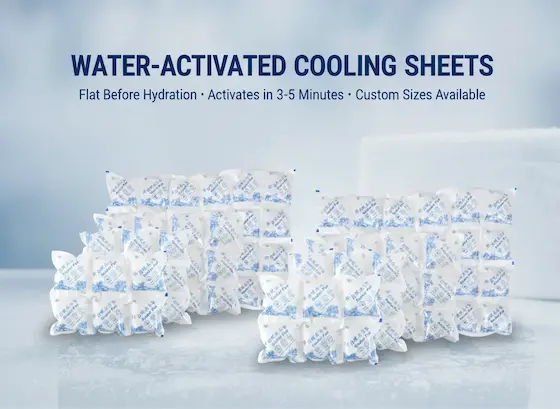
| Water-Activated Cooling Sheets | 0°C (post-hydration) | Requires manual soaking before freezing | 24 – 36 Hours | Lowest freight cost for overseas SME importers |
2. The Dry Ice Trap: Why SMEs Are Paying Thousands in Hidden Freight Penalties
For decades, dry ice was considered the default solution for sub-zero shipping. But for small-to-medium DTC sellers and international importers, dry ice has become a balance-sheet killer for three reasons:
- Exorbitant Dangerous Goods / Hazmat Surcharges: Dry ice is classified under IATA / DOT as UN1845, Class 9 Miscellaneous Dangerous Goods because it releases carbon dioxide gas as it sublimates, posing suffocation hazards in enclosed aircraft holds. Major carriers (FedEx, UPS, DHL) require specialized hazardous declarations, certified label markings, and charge $25 to $90 extra per package.
- Volumetric Loss & "Sublimation Air Voids": Dry ice doesn't melt into liquid; it sublimates directly into gas at a rate of 5 to 10 lbs (2.3 to 4.5 kg) every 24 hours. If you pack 5 kg of dry ice to protect a 2 kg salmon fillet over 48 hours, by hour 40 nearly all the dry ice has vanished into thin air. This leaves a huge empty air pocket inside the cooler box, creating a convective heat chimney that thaws the payload rapidly during the final delivery mile.
- Severe Freeze Burn on Organic Products: At -78.5°C, direct dry ice contact severely freezes cellular moisture in fish and wagyu beef, causing cellular membrane rupture, discoloration, and significant drip-loss upon thawing, which destroys the product's culinary texture.
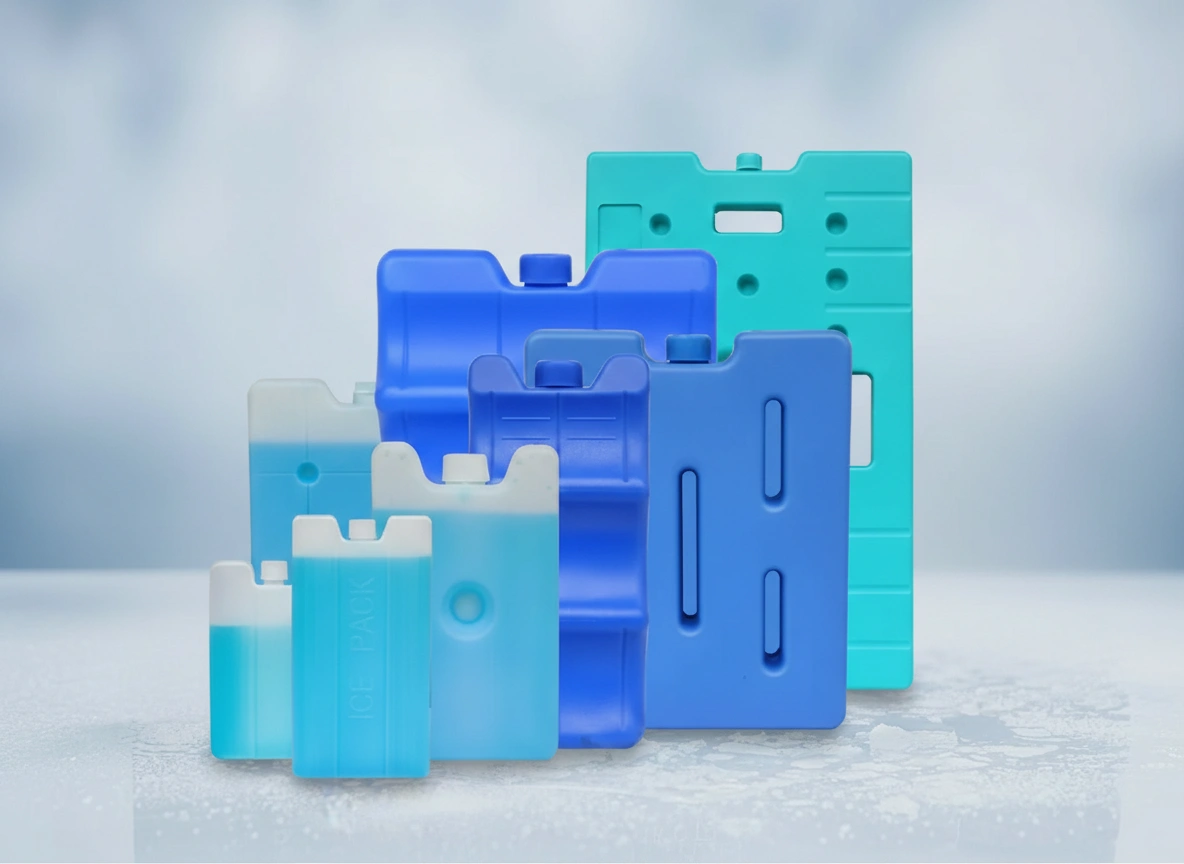
In our Guangzhou facility, we blend non-toxic eutectic inorganic salts with specialized cross-linked superabsorbent polymers (SAP) into rigid blow-molded high-density polyethylene (HDPE) containers. This achieves a stable freezing and melting plateau at -21°C (-5.8°F). It provides true deep-freeze latency, non-hazardous cargo status (certified by CNAS and DGM), zero weight loss over 72 hours, and is 100% reusable across hundreds of delivery cycles.
3. Guangzhou Engineering: Inside the HDPE Rigid Cold Pack Architecture
When we design a rigid ice pack at ColdPackPro, every millimeter of mold geometry serves a structural and thermodynamic purpose. Here is how our engineering team eliminates the defects common in generic market coolants:
1. Internal Reinforcing Pillars (Anti-Bulging Geometry)
Water expands by roughly 9% as it solidifies into ice. In a generic plastic container, this expansion causes the wide flat surfaces to balloon outward into an egg shape. Once bloated, the ice pack cannot stack flush against payload boxes, leaving large thermal gaps.
Our blow molds incorporate internal structural tie-points (through-hole pillars and ribs) that mechanically pin the front and back walls together. During freezing expansion, the container remains perfectly flat, ensuring 100% surface contact with your product for conductive cooling.
2. Ultrasonic Induction Sealing vs. Screw Caps
Screw caps with silicone O-rings are prone to micro-loosening under vibration during long sea container or overland truck transits. At ColdPackPro, our automated production lines utilize ultrasonic friction welding and induction-melted permanent HDPE plug sealing. Once sealed in our Guangzhou cleanroom, the container can withstand 2.0-meter drop tests onto solid concrete and internal hydrostatic pressures exceeding 3.5 bar without a drop of leakage.
3. Food-Grade High-Density Polyethylene
We strictly formulate with premium virgin, non-recycled eco-friendly food-grade HDPE material. Engineered for high impact resistance, chemical neutrality, and food-safe contact, this virgin HDPE resin remains tough, odorless, and ductile down to -40°C without micro-cracking or low-temperature brittleness.
4. The Guangzhou Factory SOP: How to Pre-Condition and Pack for 72-Hour Survival
A common mistake made by fulfillment centers is under-conditioning. If your blast freezer operates at -15°C, an ice pack formulated for a -21°C phase change point will never fully crystallize. It will appear hard to the touch because the surface layer has frozen, but the internal eutectic matrix remains in an unbonded, low-latent-energy state.
Standard Operating Procedure for Export Packout:
5. Total Cost of Ownership (TCO): Inbound Freight & Sourcing Realities for SMEs
When importing cold chain materials from China, many overseas procurement managers calculate only the FOB unit price of the ice pack. This is an expensive mistake. The true determinant of packaging cost is inbound volumetric freight (CBM vs. Gross Weight).
Consider a case study from one of our client brands in Los Angeles importing 10,000 units of 500g pre-filled gel packs:
- Pre-filled Gel Packs: 10,000 units × 0.5 kg = 5,000 kg (5 metric tons) of water shipped across the Pacific Ocean! You are literally paying international ocean freight and port handling fees for purified water.
- ColdPackPro Water-Activated Cooling Sheets: The same cooling capacity is shipped as ultra-thin dehydrated dry sheets weighing only 35 grams per sheet! 10,000 sheets weigh just 350 kg, occupying less than 1.2 CBM. The importer hydrates the sheets with municipal tap water in their California warehouse before freezing.
- Net Freight Savings: 84% reduction in ocean freight and terminal drayage charges, with zero sacrifice in thermal performance.
6. How to Partner with ColdPackPro for Custom OEM & Sampling
Whether you are a meal-kit startup in Melbourne, an artisanal caviar distributor in London, or an online butcher in Texas, you don't need a 50,000-unit minimum order to access real factory engineering.
At our Guangzhou manufacturing base, we offer:
- Low MOQ Customization: Custom embossed logos on rigid HDPE bricks from 2,000 pcs; custom rotogravure film printing on gel packs from 5,000 pcs.
- Target Temperature Tailoring: Custom eutectic phase change formulations for -26°C, -21°C, -16°C, -10°C, 0°C, and +2°C to +8°C.
- Complete Export Documentation: Full English CNAS Transport Identification Reports (Sea & Air), DGM Aviation Safety Certificates, Safety Data Sheets (SDS), and technical specifications supplied with every order for seamless customs clearance.
- Fast Sampling Program: Standard factory samples shipped within 3–5 business days via DHL/FedEx for your thermal chamber validation.